Your salary went up.
Your lifestyle went up faster.
Now you're working to fund a life you didn't consciously choose.
There's a name for the gap between earning more and having more. And there's a way to close it, without earning another dollar.
You didn't plan to spend $12K a month. It just... happened.
It started with the coffee. Not the $5 latte everyone warns you about. That's pocket change. It started with the thing after the coffee, and the thing after that.
You got the raise. You deserved it. And the first thing you did was move to a nicer apartment, because the old one felt small now. Then the car lease, because you were tired of worrying about breakdowns. Then the gym membership that costs more per month than your old rent. Then dinners at places where the menu doesn't have prices.
None of it felt reckless at the time. Each upgrade seemed reasonable in isolation. Earned, even.
- Used car becomes a three-year lease
- Apartment becomes a mortgage with a yard you rarely use
- Fast fashion becomes "investment pieces"
- Cooking at home becomes meal delivery, then restaurants
- A weekend hobby becomes a $400-a-month membership
And somewhere in the middle of all of it, luxuries became necessities. The upgrade became the baseline. The floor rose so gradually you didn't notice it happening.
This is lifestyle inflation. Not a spending spree, not bad decisions, not irresponsibility. Just a slow, steady drift. A series of small yeses that, taken together, cost you the thing the money was supposed to buy: freedom.
You work harder now than you did five years ago. You earn more. But the feeling of security hasn't changed. If anything, the stakes feel higher. There's more to maintain. More that depends on next month's paycheck arriving on time.
The dinner-party version of your life looks great. Nice home, nice car, nice vacation photos. But at 2 AM, when you're staring at the ceiling, you know the truth: you're on a treadmill. Running faster, going nowhere. And you're exhausted.
The gap between earning and keeping
It's not just you. The drift is structural. Prices rise, expectations rise, and the math stops working for almost everyone.
Source: 2025 Goldman Sachs Asset Management Retirement Survey
Willpower fades. A quarterly reset doesn't.
You don't need another book with 300 pages of theory. You need something that shows up four times a year, cuts through the noise, and forces a fifteen-minute reckoning with where your money actually went. That's Simple Money Magazine.
Every issue is a built-in pause button. A reason to stop running and look around. Thirty-one issues published. Every one of them waiting in the archive.
From treadmill to solid ground
"This magazine completely changed how I think about money. I used to feel so much shame about not having savings. Now I have $4,000 in the bank."Kevin L.
- ✕ Earn more, spend more, repeat
- ✕ Vague anxiety about "the future"
- ✕ No idea where $4K a month goes
- ✕ Lifestyle chosen by momentum, not you
- ✕ Can't slow down without panic
- ✓ Earn well, keep most of it
- ✓ Clear picture of where money goes
- ✓ Emergency fund that actually exists
- ✓ Spending that matches your values
- ✓ Freedom to say no to what doesn't matter
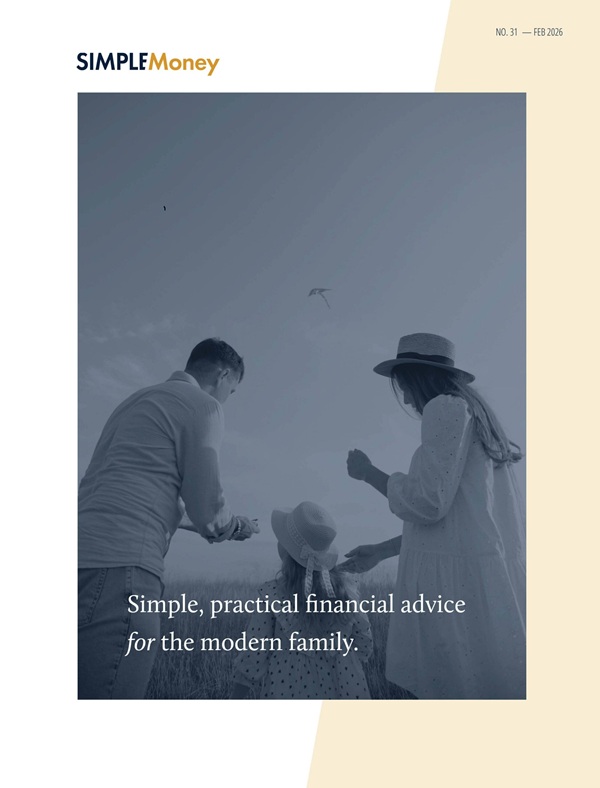
The full archive. Every future issue. And the tools to see clearly.
One payment opens the entire library. No subscriptions. No renewals. Just a system that works four times a year, every year, for as long as we publish.
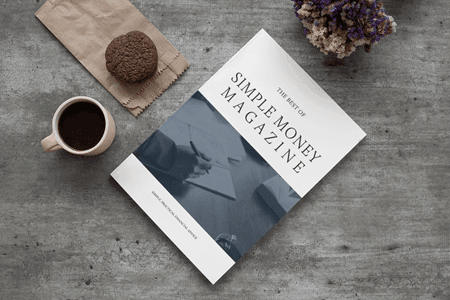
- ✓ Issue #31, the current issue
- ✓ All 30 back issues, the full archive
- ✓ Every future issue, lifetime, no renewals, ever
- ✓ 20 best essays in print, hardcover, free shipping worldwide
- ✓ Personal Spending Plan Worksheet
- ✓ Net Worth Calculator
- ✓ 10-Day Money Reset Email Series
See through the drift
Reading about money is one thing. Seeing where yours actually goes is something else. These three tools turn a vague uneasiness into numbers you can act on this week.
People who stepped off the treadmill
"We found $427 in our monthly budget we didn't know we were wasting. Within 6 months we had our first emergency fund. I can't tell you how much better I sleep."David T.
"No ads, no clickbait, just solid articles I re-read. I printed the spending plan worksheet and stuck it on my fridge. My husband and I finally talk about money without fighting."Jennifer J.
"I paid off $8,200 in credit card debt in 9 months using the strategies from Issue 3. I actually cried when I made that final payment."Michelle M.
"My wife and I were on the verge of separating because of money stress. The issue on couples and finances literally saved our marriage."Daniel L.
Less than a single dinner out.
One payment. No recurring charges. A money magazine with no subscription fee. We thought about the irony.
No subscription. One payment covers every past and future issue.
Pay once. Access everything. No recurring charges, ever.
Read everything. Use the tools. Then decide.
Get lifetime access today. Dig into the issues. Run the numbers with the worksheet and calculator. Give it 60 days. If you don't feel like something has shifted in how you relate to your money, one email gets you a full refund. No questions, no friction.
Honest Answers
"I don't need a magazine, I need an accountant."
An accountant handles your taxes. They won't ask why you spent $14K on things you can't remember last year. This handles the part that comes before the spreadsheet: the habits, the defaults, the drift. Most high earners don't have an income problem. They have an awareness problem.
"I make too much money to need help with finances."
41% of people earning $250K-$500K say they live paycheck to paycheck (2025 Goldman Sachs Asset Management Retirement Survey). Income and financial health are two different measurements. If your savings don't match your salary, the problem isn't what you earn. It's what happens after you earn it.
"What format is the magazine?"
Simple Money is a digital magazine delivered to your email as a beautifully designed PDF. Read it on any device: phone, tablet, or computer. The physical book is a separate printed hardcover shipped to your door with free worldwide shipping.
"What does 'lifetime access' actually mean?"
You pay once. You receive every past issue, every current issue, and every future issue for as long as the magazine exists. No renewals, no recurring charges, no fine print. If we ever stop publishing, you keep everything you've received.
"Is this a subscription?"
No. One-time payment. You will never be charged again. It would be a little ironic to sell a magazine about intentional spending through a recurring subscription you'd forget to cancel. One payment. Done.
"$50 seems cheap. What's the catch?"
No catch. The goal is to get this into as many hands as possible, not to maximize revenue per customer. You get the full archive (31 issues), every future issue, the printed book, and three bonus tools. If you're looking for the hidden upsell or the "premium tier" behind a paywall, it doesn't exist.
"Who writes the articles?"
Bestselling financial authors, certified financial planners, and people who've actually been on the treadmill and figured out how to step off. Every article is selected by Joshua Becker and the Becoming Minimalist editorial team. No filler, no sponsored content, no ads.
You already earn enough. It's time to keep it.
The drift didn't happen overnight. Reversing it won't either. But it starts with seeing the pattern. One payment. Every issue. The tools, the system, the quarterly reset you didn't know you needed. Sixty days to decide if it changes things.
Get Lifetime Access →One-time purchase. Every issue, yours for life. 60-day guarantee.
P.S. The $50 lifetime price won't last. It costs real money to print and ship the book worldwide. Lock in before the numbers change.
P.P.S. My newest book just hit the New York Times Best Seller list. The same thinking behind that book drives every issue of Simple Money.
P.P.P.S. My wife Kim was orphaned at birth and immediately adopted. In 2015, we used the freedom minimalism gave us to start The Hope Effect, a nonprofit providing family-based care for orphans. When you pick up Simple Money, you're supporting a company that puts its values into action.
- Joshua Becker